

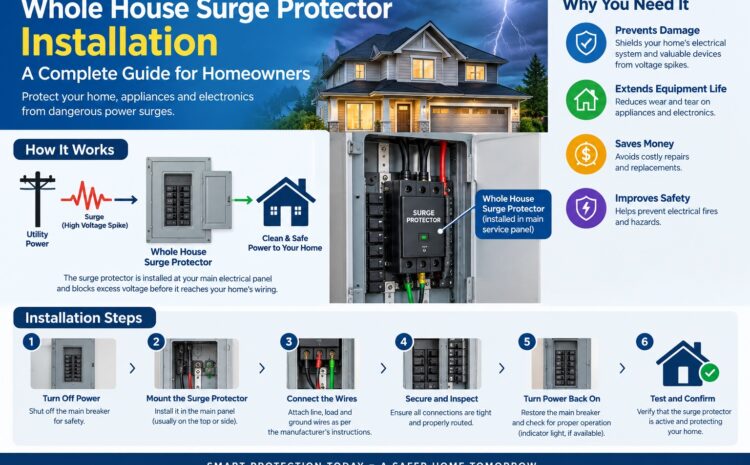
Whole House Surge Protector Installation
A Complete Guide for Homeowners
Modern American homes depend on electrical and electronic equipment every day—from HVAC systems and refrigerators to smart TVs, computers, security systems, EV chargers, and home automation devices. A sudden electrical surge can damage these systems in seconds.
A whole house surge protector, also called a whole-home surge protective device (SPD), provides an additional layer of protection by helping divert transient overvoltage away from your home’s electrical equipment.
This guide explains how whole-house surge protection works, why homeowners consider installing it, what the installation involves, how much it may cost, and what to look for when selecting a surge protection system.
What Is a Whole House Surge Protector?
A whole house surge protector is an electrical protection device installed at or near the home’s main electrical panel or service equipment.
Unlike a plug-in surge protector that protects individual devices, a whole-house SPD is connected to the home’s electrical distribution system and is designed to help protect multiple circuits and connected equipment from transient voltage events.
Common sources of electrical surges include:
Lightning-related electrical transients
Utility switching
Power-grid disturbances
Large motors and compressors switching on or off
Electrical faults
Sudden restoration of power after an outage
A whole-home surge protector does not prevent every possible electrical problem. Instead, it is designed to reduce the magnitude of transient overvoltage reaching downstream equipment.
Why Install a Whole House Surge Protector?
Many homeowners protect expensive electronics with plug-in surge strips, but today’s homes contain numerous devices that are permanently connected to the electrical system.
These may include:
HVAC equipment
Refrigerators and freezers
Washing machines and dryers
Dishwashers
Garage-door openers
Sump pumps
Furnaces
Smart-home equipment
Security systems
Home networking equipment
Computers and televisions
EV charging equipment
Pool and spa equipment
A properly selected and installed SPD can provide protection at the electrical distribution level rather than relying only on individual plug-in devices.
How Does a Whole House Surge Protector Work?
Most modern SPDs use components such as metal-oxide varistors (MOVs) to respond to transient overvoltage.
Under normal operating conditions, the SPD remains essentially inactive. When a transient voltage rises above the device’s operating threshold, the SPD provides a low-impedance path that helps divert the transient energy toward the grounding/bonding system.
The goal is to limit the voltage that downstream equipment experiences.
The effectiveness of a surge protection system depends on several factors, including:
SPD design
Surge current rating
Voltage rating
Installation location
Conductor length
Grounding and bonding
Electrical system configuration
Coordination with other protective devices
Where Is a Whole House Surge Protector Installed?
A whole-house SPD is commonly installed at or near the home’s main service equipment or electrical panel.
For a typical residential installation, an electrician may connect the SPD to appropriate circuit conductors and the equipment grounding/bonding system according to the manufacturer’s instructions and applicable electrical requirements.
The shorter the connection path between the SPD and the electrical system, the better the installation can perform during a fast transient event.
The exact installation method depends on the panel configuration, service arrangement, available breaker positions, equipment listing, and manufacturer’s instructions.
Type 1 vs. Type 2 Surge Protective Devices
Residential SPDs are commonly categorized according to where they are installed within the electrical system.
Type 1 SPD
A Type 1 SPD is generally designed for installation on the line side of the service disconnect or at locations where the applicable equipment and installation requirements permit it.
These installations are more closely associated with service entrance protection and must follow the applicable electrical requirements.
Type 2 SPD
Type 2 SPDs are commonly installed on the load side of the service equipment, such as at or near a residential electrical panel.
For many existing homes, a Type 2 SPD is a common approach for panel-level surge protection.
The correct device depends on the electrical system, equipment listing, installation location, and applicable requirements.
Whole House Surge Protector Installation Process
A typical installation involves several steps.
1. Evaluate the Electrical System
Before installing an SPD, an electrician should evaluate:
Main service rating
Panel type and configuration
Available breaker spaces
Service voltage
Grounding and bonding
Existing electrical equipment
Manufacturer requirements
Existing surge protection
Installation location
For example, a residential electrical system may be configured differently from another home even if both have similar panel ratings.
2. Select the Appropriate SPD
The surge protective device should be compatible with the home’s electrical system and properly listed for the intended application.
Important specifications can include:
System voltage
Maximum continuous operating voltage (MCOV)
Nominal discharge current
Surge current rating
Short-circuit current rating
Protection modes
Response characteristics
Enclosure/environmental rating
Manufacturer installation requirements
3. Install the Device
The electrician installs the SPD according to its listing and manufacturer’s instructions.
Depending on the equipment, the SPD may be connected through a dedicated circuit breaker or another approved configuration.
The installation must maintain appropriate conductor routing, termination, overcurrent protection, grounding, bonding, and clearances.
4. Verify the Installation
After installation, the electrician should verify that:
Connections are properly terminated
The SPD is correctly connected
Grounding and bonding are appropriate
The protective device is compatible with the panel
The installation complies with applicable requirements
The SPD status indicator is functioning, when provided
How Much Does Whole House Surge Protector Installation Cost?
The cost varies significantly by location, electrical panel configuration, SPD type, labor rates, and installation complexity.
A simple installation on an accessible residential panel may cost considerably less than an installation requiring panel modifications, replacement equipment, additional wiring, or correction of existing electrical deficiencies.
Homeowners should request a written estimate that separates:
Surge protector equipment
Labor
Required breakers or accessories
Permit costs, if applicable
Additional electrical work
Inspection costs, where applicable
Rather than selecting a surge protector based solely on price, homeowners should consider the device’s specifications, listing, warranty, installation requirements, and compatibility with the home’s electrical system.
Does a Whole House Surge Protector Protect Against Lightning?
A whole-house SPD can help reduce damage from certain transient electrical events, including some surges associated with lightning.
However, no surge protective device can guarantee protection against a direct lightning strike or every possible electrical surge.
Lightning can involve extremely large amounts of energy and can enter a property through multiple pathways, including electrical, communication, grounding, and other conductive systems.
For properties in areas with significant lightning exposure, a comprehensive lightning protection and surge protection strategy may be appropriate.
Whole House Surge Protector vs. Plug-In Surge Protector
These two technologies serve different purposes.
| Feature | Whole-House SPD | Plug-In Surge Protector |
|---|---|---|
| Installation | Electrical panel/service equipment | Electrical receptacle |
| Protection scope | Multiple circuits | Connected devices |
| Typical use | Home electrical system | Individual electronics |
| Installed by | Qualified electrician | Homeowner/user |
| Protects permanently wired equipment | Yes, when properly designed | Generally no |
| Provides layered protection | Yes | Yes |
| Replacement | Depends on device condition/status | Periodic replacement may be appropriate |
For many homes, these systems can be used together as part of a layered surge protection strategy.
Do You Still Need Plug-In Surge Protectors?
In many situations, yes.
A whole-house SPD and point-of-use surge protection can complement each other.
Sensitive electronics such as computers, televisions, networking equipment, and home entertainment systems may benefit from additional point-of-use protection.
For particularly sensitive equipment, homeowners should follow the equipment manufacturer’s recommendations.
How Long Does a Whole House Surge Protector Last?
There is no universal replacement interval for every SPD.
Surge protective devices can degrade after absorbing transient energy. Many products include an indicator showing whether the protection components remain operational.
Some modern SPDs provide visual or audible status indicators and may have replaceable protection modules.
Homeowners should periodically inspect the device and follow the manufacturer’s instructions regarding testing, status indicators, and replacement.
What Happens When a Surge Protector Fails?
An SPD may eventually reach the end of its useful life after exposure to surge events.
Depending on the device design, a failure indicator may change state or show that protection is no longer available.
Some SPDs are designed with internal protective mechanisms to disconnect failed components from the electrical system.
If an SPD indicates failure, it should be evaluated and replaced according to the manufacturer’s instructions.
Is Whole House Surge Protection Required by Code?
Whether surge protection is required depends on the applicable edition of the National Electrical Code (NEC) and local requirements, as well as the type of installation and equipment involved.
Code requirements can change between NEC editions and jurisdictions.
For that reason, homeowners should not assume that an installation requirement in one state, city, or county automatically applies everywhere in the United States.
A licensed electrician should verify the requirements applicable to the specific property and project.
Why Professional Installation Matters
A whole-house surge protector is connected directly to a home’s electrical distribution system. Improper installation can create serious electrical hazards.
Professional installation helps ensure that:
The SPD is compatible with the electrical system
Conductors are correctly sized and routed
Connections are properly terminated
Grounding and bonding are appropriate
Required overcurrent protection is provided
The device is installed according to its listing
Applicable electrical requirements are followed
Homeowners should use a properly qualified electrical professional rather than attempting panel-level electrical work without the required training and authorization.
What Should You Look for When Choosing a Whole House Surge Protector?
When comparing SPDs, don’t focus on only one specification.
Consider:
1. System Compatibility
Verify that the SPD is designed for your electrical system’s voltage and configuration.
2. Surge Current Rating
Manufacturers may publish a maximum surge current rating. This specification should be evaluated along with the device’s other characteristics rather than used as the only purchasing criterion.
3. MCOV
Maximum Continuous Operating Voltage (MCOV) indicates the maximum continuous voltage the SPD is designed to withstand under specified conditions.
4. Protection Modes
Different SPDs provide protection across different conductor combinations or modes.
5. Status Indication
A clear visual indication can help homeowners determine whether the protective components remain operational.
6. Listing and Certification
Look for products that are properly listed/certified for their intended application and installed according to the manufacturer’s instructions.
7. Warranty
Review the manufacturer’s warranty carefully, including its limitations and conditions.
Common Whole House Surge Protection Mistakes
Mistake #1: Choosing Only by Price
The cheapest device may not be the best match for the home’s electrical system.
Mistake #2: Ignoring the Grounding System
Surge protection depends on the complete electrical installation. An SPD cannot compensate for an improperly designed or deficient grounding/bonding system.
Mistake #3: Using Excessively Long Conductors
Long connection paths can negatively affect transient protection performance.
Mistake #4: Assuming One Device Protects Everything
A panel-mounted SPD primarily addresses electrical power transients. Communication, cable, telephone, antenna, and other conductive pathways may require their own appropriate surge protection.
Mistake #5: Forgetting Permanently Connected Equipment
Homeowners often focus on televisions and computers while overlooking HVAC systems, appliances, pumps, garage-door openers, and other expensive equipment.
Should You Install a Whole House Surge Protector?
Whole-home surge protection can be considered as one component of a broader electrical protection strategy, particularly for homes containing substantial amounts of electronic equipment or sensitive electrical systems.
The appropriate solution depends on:
Your home’s electrical service
Local electrical requirements
Lightning exposure
Utility conditions
Equipment sensitivity
Existing surge protection
Grounding and bonding conditions
Installation cost
A qualified electrician can evaluate the property and determine an appropriate solution.
Frequently Asked Questions
How long does whole-house surge protector installation take?
A straightforward installation may be completed relatively quickly, but the actual time depends on the electrical panel, installation location, wiring configuration, accessibility, and whether additional electrical work is required.
Can I install a whole-house surge protector myself?
Panel-level electrical work can expose you to dangerous voltages even when the main breaker is switched off. Installation should be performed by a qualified electrician familiar with the applicable electrical requirements and the manufacturer’s installation instructions.
Does a surge protector reduce my electricity bill?
No. A surge protective device is designed primarily for transient voltage protection. It is not an energy-efficiency device and should not be expected to produce meaningful electricity-bill savings.
Does it protect my HVAC system?
A properly installed whole-house SPD can help reduce the effects of certain electrical transients reaching connected equipment, including HVAC equipment. It does not guarantee that an HVAC system will never be damaged by a surge or lightning event.
Do I need surge protection if I have a newer home?
Newer construction does not eliminate the possibility of electrical transients. Whether additional surge protection is appropriate depends on the home’s electrical system and applicable requirements.
Does a whole-house surge protector protect against power outages?
No. Surge protection and backup power are different functions.
An SPD is designed primarily to address transient overvoltage. A standby generator, UPS, or other backup-power system serves a different purpose.
Final Thoughts
A whole house surge protector installation can add an important layer of protection to a modern home’s electrical system.
With HVAC equipment, smart appliances, computers, networking equipment, entertainment systems, security devices, EV chargers, and other electronics becoming increasingly common, homeowners have more equipment that can potentially be affected by electrical transients.
The best approach is not simply to purchase the largest-rated surge protector available. The device should be properly selected for the electrical system, correctly installed, appropriately grounded and bonded, and maintained according to the manufacturer’s instructions and applicable electrical requirements.
For homeowners considering installation, the next step is to have a qualified electrician evaluate the existing electrical panel and recommend an SPD that is compatible with the home’s service and local requirements.








Write a Comment